
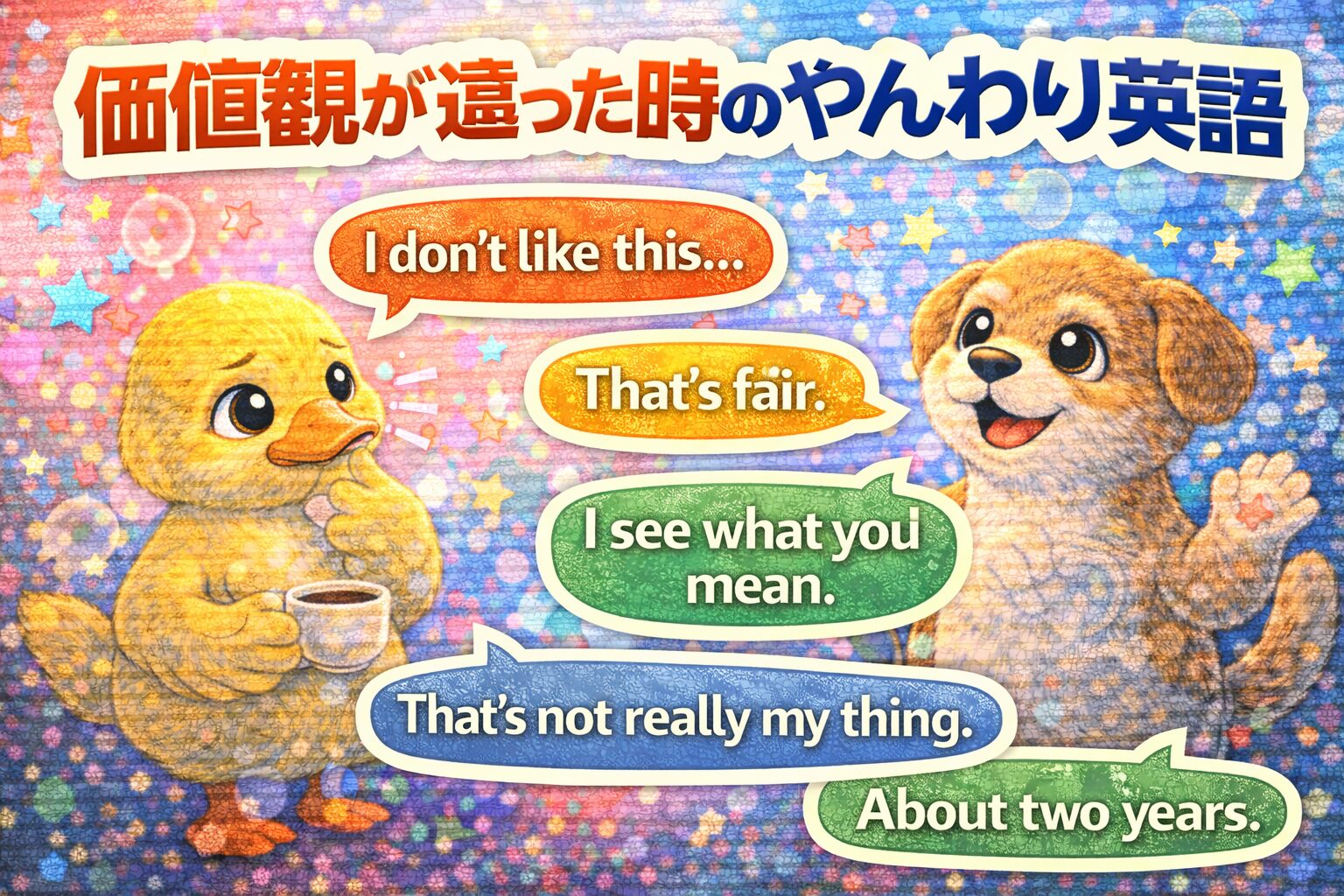
- ✅ 3行まとめ(結論)|外国の人と価値観が違った時のやんわり英語は「共感→立場→質問」で角が立たない
- ✅ 今日の会話ミッション(コピペ可)|価値観が違った時に“角の立たない返し”を1回だけ使う
- ✅ 使える短文3つ(丁寧/カジュアル/超短い)|価値観の違いをやんわり英語で伝える
- ✅ 会話を伸ばす追加質問3つ|価値観が違う時に“喧嘩せず深掘り”する
- ✅ リアルな会話劇で学んでみよう|価値観の違いをやんわり英語SNSで返す(5ターン以上)
- ✅ 使えるフレーズ|価値観の違いをやんわり伝える英語SNSフレーズ90(共感/距離/反対/着地)
- ✅ NG例(誤解・失礼防止)|価値観が違う時の英語SNSで炎上しやすい言い方
- ✅ 発音(カタカナ+アクセント)|価値観の違いをやんわり伝える英語
- ✅ 1分練習(音読)|価値観が違う時のやんわり英語SNSを反射にする
✅ 3行まとめ(結論)|外国の人と価値観が違った時のやんわり英語は「共感→立場→質問」で角が立たない
SNSで価値観が違う人に出会った時、正論で殴るより“空気を守って会話を続ける”方が大人です(そして勝ちやすい)。
結論は「①相手の意図を尊重(I see your point)→②自分の立場を柔らかく(For me / In my experience)→③質問で着地(What makes you feel that way?)」の型。
迷ったら、“I see what you mean. For me, it’s a bit different. I’m curious—why do you think so?” の1セットでOK。炎上より会話を選びましょう(スマホも心も発熱します)。
価値観の違いは“間違い”じゃなく“前提の違い”:
国・文化・宗教・教育・家庭環境で「当たり前」が変わります。だからSNSでは、相手を変えるより誤解を減らして距離感を調整するのが現実的。
英語教育の観点でも、やんわり表現(hedging)は国際コミュニケーションの必須スキル。強い言い方を避けるだけで、あなたの英語は一気に“上級者の匂い”がします。
✅ 今日の会話ミッション(コピペ可)|価値観が違った時に“角の立たない返し”を1回だけ使う
今日の一言(コピペでOK)
I see your point. For me, it’s a bit different, but I respect your view 😊
相手が食い下がってきたら(万能返し)
That makes sense. I’m curious—what makes you feel that way? 😄
✅ SNSは“正しさ”より“安全な距離感”が大事:
価値観が違う相手ほど、文章だけのSNSは誤解が起きやすいです。Langmateのように国際交流を前提とした場だと、相手も「違い」を楽しむ姿勢がある人が多く、やんわり英語の練習に向いています。
▶ Langmateで“価値観の違いを上品に扱う英語”を練習して、SNSでも揉めない会話力を作る(無料でOK)
ポイント:否定から入らず、「理解→自分→質問」の順番にすると角が立ちません。
✅ 使える短文3つ(丁寧/カジュアル/超短い)|価値観の違いをやんわり英語で伝える
- 丁寧:I respect your opinion. I just see it a bit differently.(意見は尊重します。少し違う見方です)
- カジュアル:I get you—my take is a little different 😅(わかる。でも自分はちょい違うかも)
- 超短い:Fair point.(それも一理ある)
使い分けのコツ:
・丁寧=職場/初対面/コメント欄で安全
・カジュアル=DMや軽い雑談で自然
・超短い=一旦火を消して、次の一文(自分の立場)へ繋ぐ
✅ 会話を伸ばす追加質問3つ|価値観が違う時に“喧嘩せず深掘り”する
- What makes you feel that way?(そう思う理由は?)
- Is that common where you’re from?(あなたの国では一般的?)
- What would be a good middle ground?(落としどころってある?)
ワンポイント:相手を論破する質問ではなく、背景を引き出す質問にすると“良い議論”になります。
✅ リアルな会話劇で学んでみよう|価値観の違いをやんわり英語SNSで返す(5ターン以上)
シチュエーション:コメント欄で意見が割れる→尊重→自分の立場→質問→着地
Them(相手):I think people should always be brutally honest online.(ネットは常に正直であるべき)
You(あなた):I see what you mean. Honesty matters.(言いたいことは分かる。正直さは大事)
You:For me, kindness also matters—especially online, where tone gets lost easily.(自分は優しさも大事だと思う。SNSはニュアンスが消えるし)
Them:But people are too sensitive.(でもみんな敏感すぎ)
You:Fair point 😄 At the same time, I’d rather be clear and kind. (My keyboard is already dramatic enough.)(一理ある。でも自分は“明確+優しさ”派。キーボードがすでにドラマチックだからね)
You:I’m curious—what’s your goal when you’re brutally honest? To help, or to vent?(聞きたいんだけど、目的は?助けたい?それとも発散?)
Them:Mostly to help.(主に助けたい)
You:That makes sense. If the goal is to help, maybe we can keep the message clear but soften the tone a bit.(なるほど。助けたいなら、内容は明確にしつつトーンは柔らかくできそう)
この会話のポイント:
✅ “I see what you mean” で敵対を避ける
✅ “For me / especially online” で自分の前提を説明する
✅ ユーモアは1回だけ(温度を下げる)
✅ 相手の目的を質問して、落としどころへ誘導する
✅ 使えるフレーズ|価値観の違いをやんわり伝える英語SNSフレーズ90(共感/距離/反対/着地)
ここからが本編です。価値観が違う時に強いのは、断言ではなく“クッション言葉(hedging)”です。
これを使えると、あなたの英語は一気に“大人の国際コミュ力”になります。
目標は、相手を言い負かすことではなく、誤解を減らして関係を壊さないこと。SNSはスクショが長生きするので、言葉は短命に、品は長命にいきましょう。
① まず共感・尊重(Agree / Respect)(20)
- I see your point.(言いたいことは分かる)
- I get what you mean.(意図は分かる)
- That’s a fair point.(一理ある)
- I can see why you’d think that.(そう思うのも分かる)
- Thanks for sharing your perspective.(視点共有ありがとう)
- I appreciate your honesty.(正直さに感謝)
- You make a good point.(良い点だね)
- That’s interesting.(興味深い)
- I hadn’t thought of it that way.(その見方はなかった)
- I respect your opinion.(意見を尊重する)
- We might value different things.(大事にするものが違うかも)
- Different people have different experiences.(経験が違う)
- I’m glad we can talk about it.(話せて嬉しい)
- It’s a nuanced topic.(繊細な話題だね)
- There’s more than one way to see it.(見方はいろいろ)
- I’m not here to argue.(喧嘩する気はない)
- I’m here to understand.(理解したい)
- Let’s keep it respectful.(敬意を持って)
- Let’s agree to disagree.(違いを認めよう)
- No hard feelings.(気にしないで)
② 自分の立場をやんわり(Soft disagreement)(24)
- For me, it’s a bit different.(自分は少し違う)
- Personally, I see it another way.(個人的には別視点)
- In my experience, it depends.(経験上、場合による)
- I’m not sure I fully agree.(完全には同意できない)
- I see it a little differently.(少し違って見える)
- That might be true in some cases.(場合によっては)
- I think it’s more complicated than that.(もっと複雑かも)
- I’m not convinced that’s always the case.(いつもそうとは思わない)
- I worry that could lead to…(それだと〜が心配)
- I’d be careful with that generalization.(一般化は注意)
- Maybe we’re talking about different situations.(状況が違うかも)
- We may be using the word differently.(言葉の定義が違うかも)
- From where I stand, …(自分の立場では)
- I tend to prioritize (kindness).(自分は〜を優先)
- I get the idea, but…(分かるけど…)
- I hear you, but…(そうだね、でも…)
- Not necessarily.(必ずしも)
- That’s not how I see it.(自分はそう見ない)
- I’m on the fence.(どっちとも)
- I’m still thinking about it.(まだ考え中)
- I might be missing something.(見落としてるかも)
- Correct me if I’m wrong.(違ったら教えて)
- Let me clarify what I mean.(意図を明確にするね)
- To be clear, I’m not attacking you.(攻撃じゃないよ)
③ 相手を理解する質問(Curious questions)(22)
- What makes you feel that way?(そう思う理由は?)
- What’s your main concern?(一番の懸念は?)
- What do you mean by (word)?(その言葉の意味は?)
- Can you give an example?(例ある?)
- Is that common where you’re from?(そっちでは一般的?)
- How does it work in your country?(あなたの国では?)
- What’s your goal here?(目的は?)
- What would be ideal for you?(理想は?)
- What would be a good middle ground?(落としどころは?)
- What do you value most in this situation?(何を一番大事にする?)
- Do you think it depends on context?(状況次第?)
- What’s an exception to that?(例外は?)
- How would you handle it?(どう対処する?)
- What experience led you to that view?(経験の背景は?)
- Has something happened to you?(何かあった?)
- What do you think is misunderstood?(誤解されがちな点は?)
- What would you say to someone who disagrees?(反対派に何と言う?)
- Do you want advice or just to share?(助言がほしい?共有?)
- Are we talking about values or facts?(価値観?事実?)
- Can we define the terms first?(定義合わせる?)
- What’s the takeaway for you?(結論は?)
- What do you hope happens next?(次どうなると良い?)
④ 角を立てずに着地(Exit / soften / set boundaries)(24)
- Thanks—this is helpful to hear.(聞けて助かる)
- We can agree to disagree.(違いを認めよう)
- I think we value different things—and that’s okay.(大事にするものが違う、それでOK)
- Let’s keep it respectful.(敬意を持って)
- I’d rather not argue online.(SNSで議論したくない)
- I don’t want this to get heated.(荒れたくない)
- Let’s pause here.(一旦ここまで)
- I’ll think about what you said.(考えてみる)
- That’s a good perspective to consider.(考慮すべき視点)
- I might still disagree, but I respect you.(反対でも尊重)
- I’m not comfortable discussing this further.(これ以上は控えたい)
- Let’s switch to another topic.(話題変えよう)
- Wishing you a good day.(良い一日を)
- No worries—thanks for the chat.(ありがとう)
- Let’s keep it kind.(優しくいこう)
- Text doesn’t always show tone.(文章はトーンが出ない)
- I might be reading it wrong.(読み違いかも)
- To avoid misunderstandings, I’ll keep it brief.(誤解防止で短く)
- I don’t want to assume your intent.(意図を決めつけたくない)
- Let’s focus on what we agree on.(一致点に集中)
- I think we both want a good outcome.(良い結果を望んでる)
- We can revisit this later.(また今度)
- I’ll leave it there.(ここで終わるね)
- Take care.(お大事に/気をつけて)
⭐ 最強テンプレ(迷ったらこれ)
I see your point. For me, it’s a bit different, but I respect your view.
I’m curious—what makes you feel that way?
上品ユーモアの入れ方(1回だけ):
・相手を笑うのはNG(攻撃に見える)
・自分を少しだけ落とすのはOK(温度が下がる)
例:“My English is a work in progress, but here’s my take…”
ユーモアは“香水”です。近づいた時に気づくくらいがちょうどいい。
✅ 価値観の違いは“練習すると強くなる”分野:
こういうやんわり表現は、知っていても実戦で出ないことが多いです。Langmateのように国際交流前提の場で、短文で何度も使うと、SNSでも自然に返せるようになります。
▶ Langmateで“価値観の違いを丸く扱う英語”を反復して、SNSのコメント/DMでも大人に対応する
✅ NG例(誤解・失礼防止)|価値観が違う時の英語SNSで炎上しやすい言い方
NG①:断言で切る(相手の逃げ道ゼロ)
- ❌ You’re wrong.(あなたが間違い)
- ✅ I see it differently.(自分は違う見方)
NG②:人格攻撃になる(議題が消える)
- ❌ You’re ignorant.(無知だ)
- ✅ I think there may be another angle.(別の角度もあるかも)
NG③:皮肉が強すぎる(文字だと毒が濃い)
- ❌ Wow, genius idea.(皮肉)
- ✅ That’s an interesting take.(柔らかい)
まとめ:英語SNSは「尊重→自分→質問」。断言・人格・皮肉を避けるだけで、トラブルが激減します。
✅ 発音(カタカナ+アクセント)|価値観の違いをやんわり伝える英語
※アクセントは大文字のところを少し強く読んでください。
- respect(リスペクト)
- opinion(オピニオン)
- perspective(パースペクティヴ)
- value(ヴァリュー)
- different(ディファレント)
- curious(キュリアス)
- context(コンテクスト)
- misunderstanding(ミスアンダースタンディング)
- middle ground(ミドル グラウンド)
- agree to disagree(アグリー トゥ ディスアグリー)
超入門の発音ポイント:
“I see your point” は “アイ スィー ユァ ポイント” のように滑らかに。
“For me” は “フォァ ミー” に近い音。短く言うほど自然になります。
✅ 1分練習(音読)|価値観が違う時のやんわり英語SNSを反射にする
- 20秒:共感+立場
I see your point.
For me, it’s a bit different, but I respect your view. - 20秒:質問で深掘り
I’m curious—what makes you feel that way?
Is that common where you’re from? - 20秒:着地(穏やかに終える)
Thanks for sharing your perspective.
We can agree to disagree—no hard feelings 😊
今日の合格ライン:“I see your point.” を自然に言えたら勝ち🎉